
6 Aug 2026 · 8 min read
Rethinking the PCA for Agentic Campaigns
The post-campaign analysis is the closing ceremony of every media relationship. The wrap deck. The learnings. The slide titled What We Would Do Differently. It is the artefact agencies are measured on and the one clients actually read, the moment a season of media gets narrated back as a story with decisions and reasons and a tidy set of takeaways for next time.
There is a version of the agentic argument that says this ritual is finished. That once a machine does the buying, the analyst is reduced to reading a log they never watched being written, and the wrap report becomes an exercise in archaeology. It is a tidy, provocative thesis, and it is wrong. The PCA does not die when the buyer is a machine. It comes apart into the two separate jobs it was always quietly doing at once.
Two questions in one deck
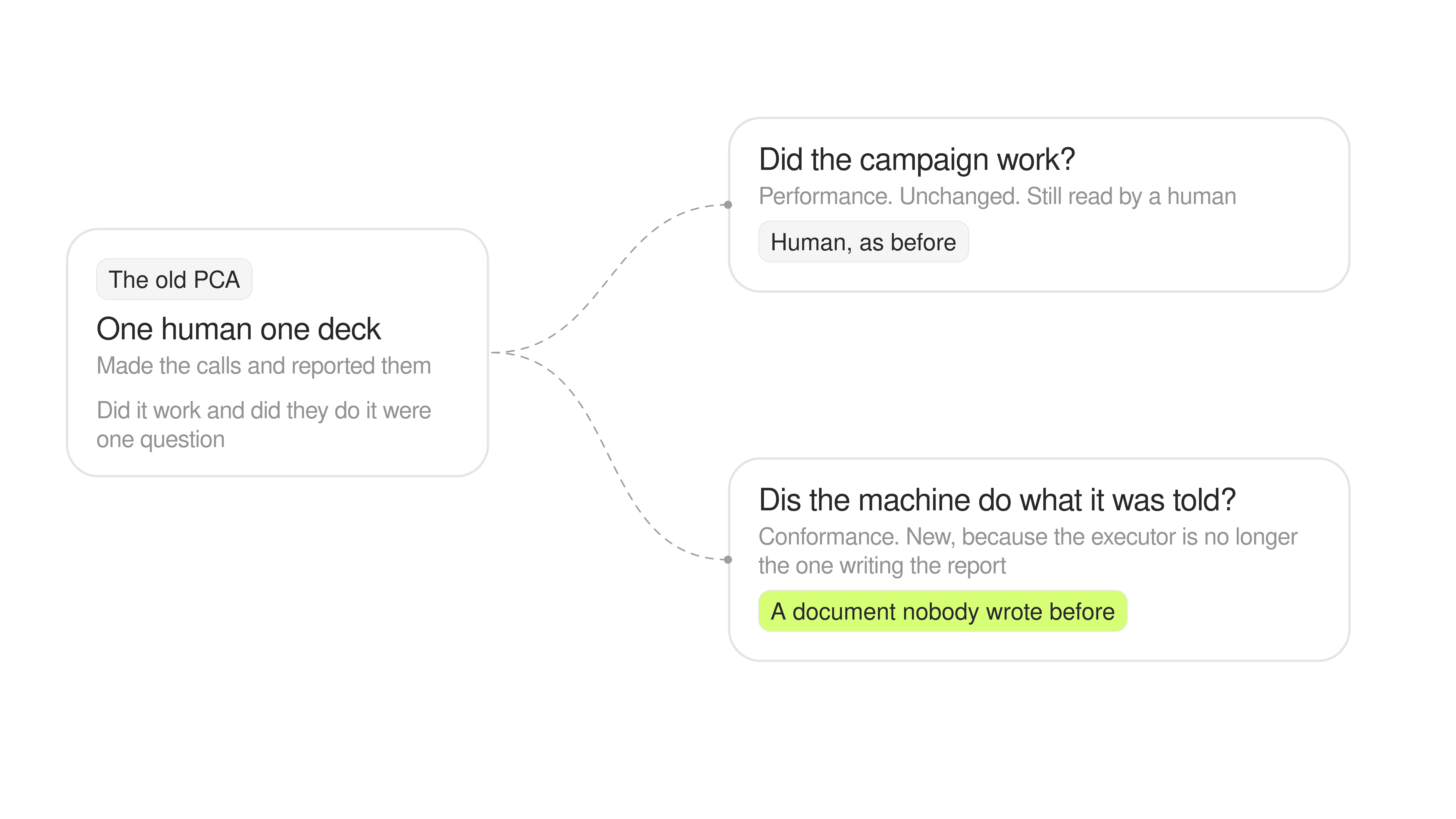
Every wrap report has ever answered two different questions that felt like one.
The first is: did the campaign work. Did the money buy attention, did the placements perform, what should we do more of next time. This is the analysis. It is the part the client reads, and it is the reason the meeting exists.
The second is quieter, and until now it was invisible, because it was never a separate question. It is: did the person who ran this do what they said they would. Did they hold to the plan, respect the exclusions, keep spend inside the budget. Nobody wrote that section, because nobody needed to. The analyst answering question one was the same person who had made every call in question two. When the human who shifts a budget is also the human who writes the report, "did they do it" and "did it work" collapse into a single enquiry. You do not audit your own hands. You just explain what they did.
That collapse is the thing that breaks. Not the report. The collapse.
Why the two questions come apart
Change one thing. The person did not make the decisions. An agent did.
The moment the executor and the analyst are no longer the same entity, the two questions separate, and they separate cleanly. Question one is untouched. Somebody still has to look at what the campaign delivered and decide whether it was any good, and that somebody is still a human reading performance, exactly as before. If anything the job gets weightier, because the read on this campaign is about to be fed to a system that will act on it at scale next time, but the nature of the work is the same. Performance analysis does not care who pulled the levers.
Question two is where everything changes, because for the first time there is a gap between the hand that acted and the head that reports. And that gap has a speed problem underneath it.
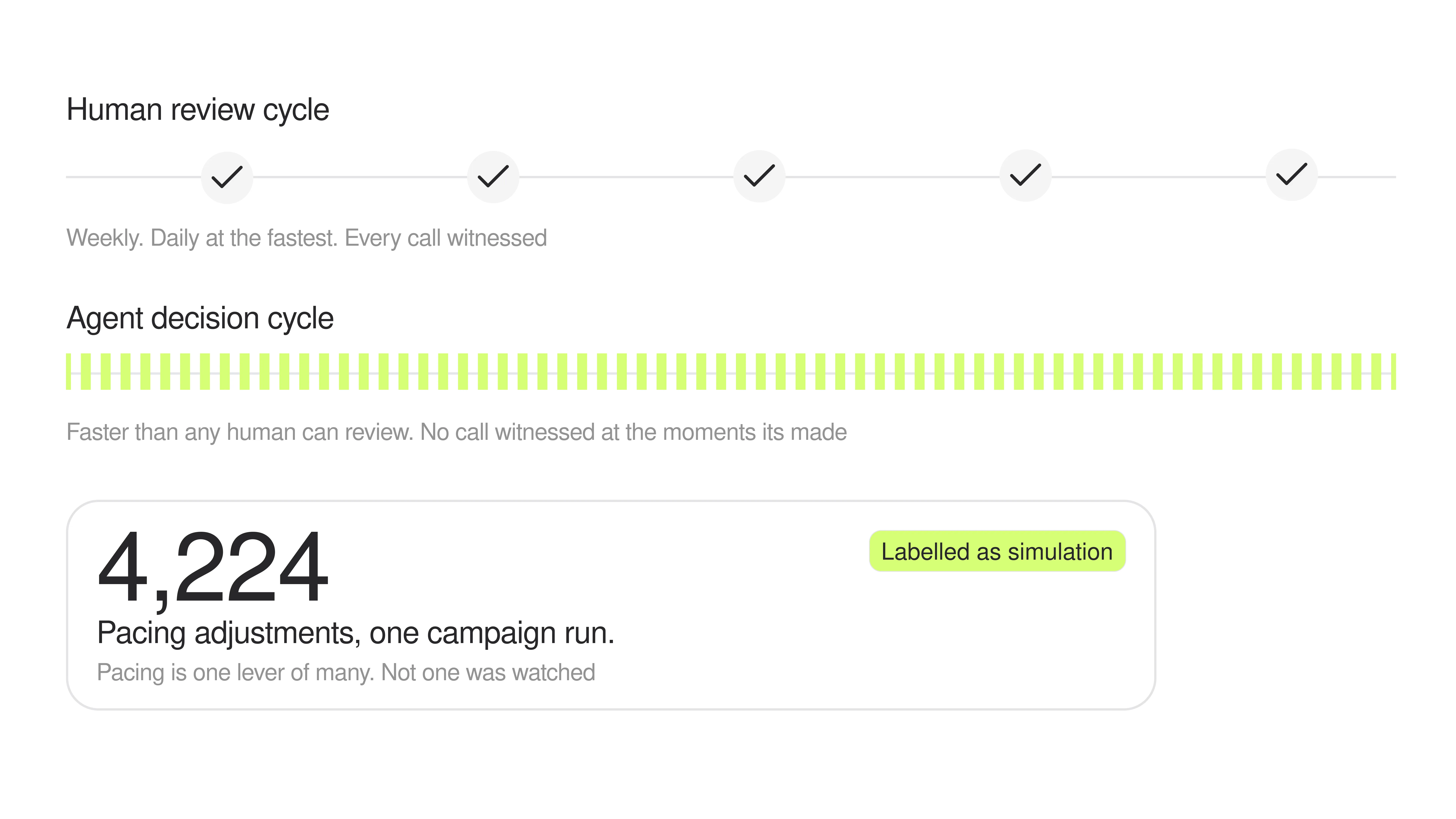
A human decision cycle runs weekly, daily at the fastest. An agent runs faster than any human can review, and no person sees the individual calls at the moment they are made. Put a number on it. In one controlled simulation, a single agentic scenario logged 4,223 pacing adjustments across the run, and pacing is only one of the levers an agent works (labelled as simulation). Nobody watched those 4,223 calls. So the old method for answering question two, a person recalling their own reasoning, is simply gone. You cannot recall a decision you never made.
This is the honest core of the archaeology worry, and it is worth keeping, because it is true about question two. What the machine did during the campaign can no longer be reconstructed from memory after the fact. It has to be recorded as it happens or it is lost. But notice the worry applies only to the conformance half. It says nothing about whether the campaign worked. A performance analyst never reconstructed every pacing call in a manual campaign either, and the wrap report worked fine. The speed problem does not touch question one. It lands entirely on question two.
Conformance is a document, not a footnote
So the new section is not a smaller wrap report or a faster one. It is a different document with a different purpose, sitting alongside the performance analysis rather than replacing it.
Did the agent stay inside the exclusions it was given. Did it hold to the budgets, respect the brand safety floors, keep pacing within the envelope it was handed. This is not judgement retold. It is a statement of what was asked for and the evidence the machine did it. And it is the part nobody currently writes, because until the buyer became a machine there was no reason to write it.
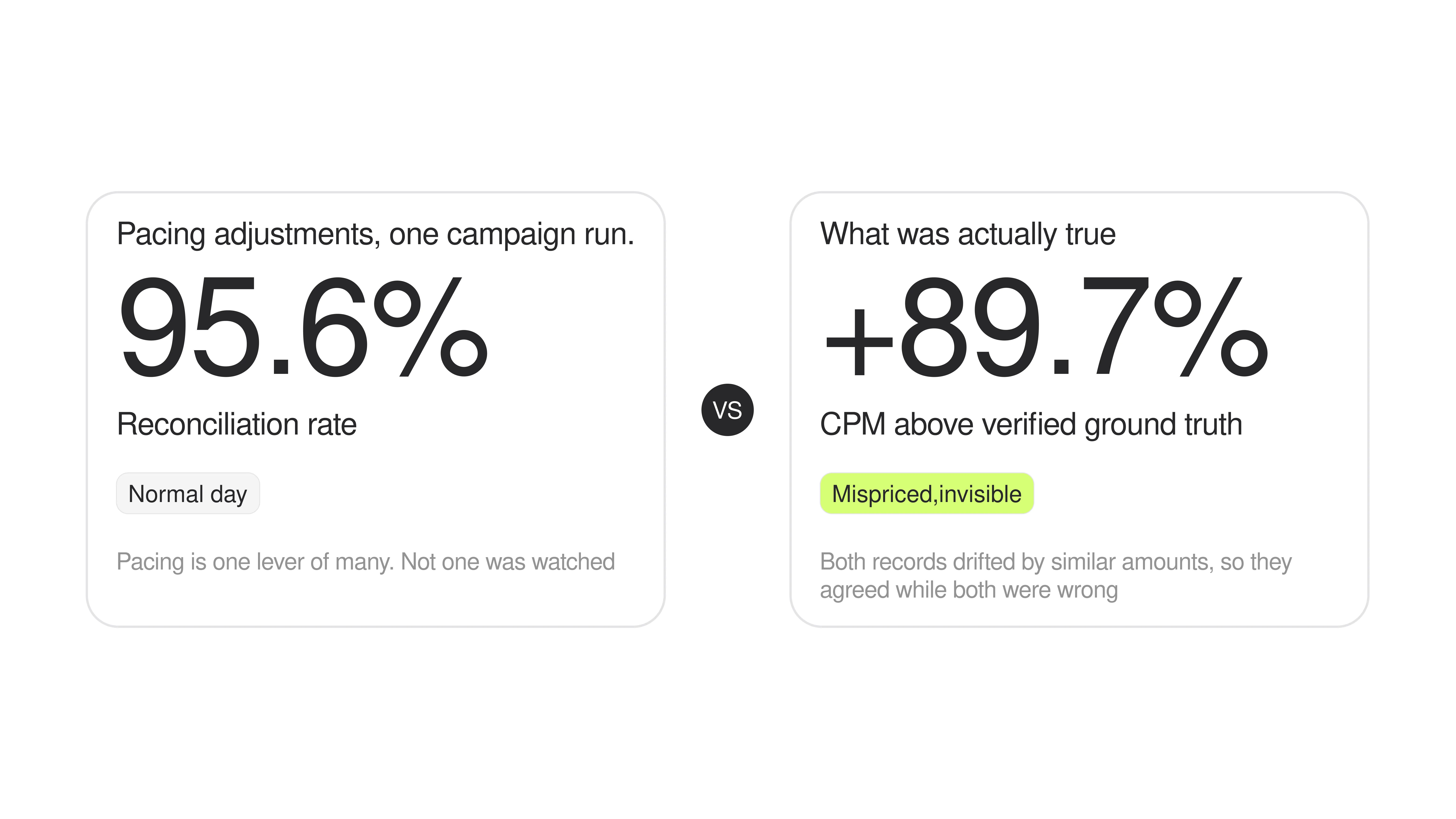
There is a reflex here worth heading off. The reflex is that a richer dashboard closes this gap. It does not, and the reason is uncomfortable. The reporting layer inherits a flaw the transaction layer already has. In the same body of simulation work, records could diverge from the truth while the reconciliation dashboard showed a clean day. On day 22 of one run, a buyer system was carrying a CPM 89.7% above the verified figure, and the dashboard showed a normal 95.6% reconciliation rate with no alert raised (labelled as simulation). The books balanced. The number was wrong. A conformance report built on top of that is narrating from figures that agreed with each other without being true. A better visualisation of a wrong number is a prettier wrong number.
Mid-flight, answered
Here is the objection a programmatic veteran raises before this paragraph ends, and it is the right one. The human did not leave. Mid-flight, someone was watching. Someone caught the drift, made the calls, steered the campaign. The tidy "PCA is now archaeology" thesis has no answer to this. The split does.
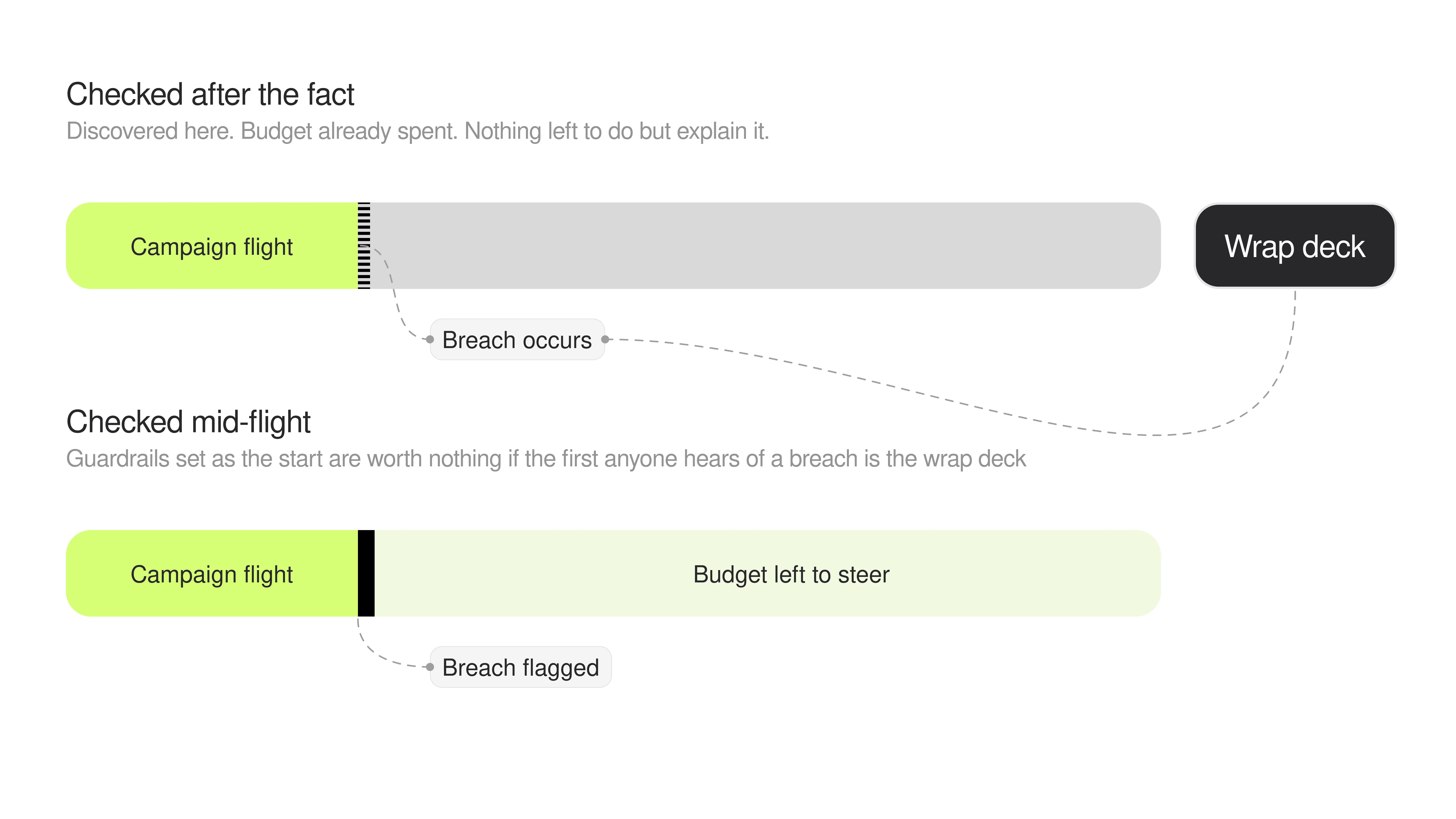
The human did not leave the loop. The human moved up a level, on the buying side. The job stopped being making the individual calls and became setting the conditions the agent runs inside, then holding it to them. But moving up a level does not solve mid-flight on its own, and this is the part the original argument waved through. Setting good guardrails at the start is worth nothing if the first time anyone learns the agent breached them is in the wrap deck, when the budget is already spent. Conformance discovered after the campaign is a receipt for a mistake you can no longer prevent.
So the real mid-flight requirement is not a person catching a bad placement in week three. It is a mechanism that flags a breach while there is still budget left to steer. The guardrail has to be checkable during the flight, not just after it. That is a harder ask than the old model ever made, and pretending the human simply "moved up a level" hides how much harder.
What the conformance half actually needs
Three things, and a current agent reliably produces none of them. Phrased so they can go straight into a brief rather than sitting in a chat as product features.
One. A legible statement of the intent the agent was given, fixed at the start, so there is something definite to check execution against rather than a vague recollection of the brief.
Two. A record of what the agent actually did, produced as it operated, not reconstructed afterwards from whatever happened to survive.
Three. A way to check the second against the first that a client can read, and that can be read during the flight, not only at the end of it.
A conformance report a client cannot follow is not a conformance report. It is a log file with ambitions. And a conformance check that only runs after settlement answers the wrong question. It tells you whether you were let down. It does not tell you in time to stop it.
This is where a verification record earns a place, and it earns it on the conformance half alone. It does nothing for whether the campaign worked, and it should not pretend to. What it does is make the second requirement answerable, a record of what the agent did that neither the agent nor anyone else can quietly revise after the fact. You are the one who has to sit across the table and tell a client the agent did what they briefed. "The tool said so" is not an answer you can give. A record the tool cannot rewrite is. Demand it whether or not any current agent offers it, because without it the conformance section is a story you are asking the client to take on faith, which is the one thing conformance was supposed to end.
The performance analyst still reads the campaign and still writes the learnings, and that job is now more consequential than ever, because the learnings feed the machine that runs the next one.
And the judgement that used to sit inside the buying, knowing which exclusions matter, which floors are real, which pacing envelopes are worth defending, has not vanished. It moved to the front of the campaign. It became the brief. The analyst who could read a campaign after the fact is the person who can specify one before it starts.
Which is the quiet promotion, and it is a real one this time, not a flattering one. The most important instruction in an agentic campaign is now written before the campaign runs. The most important question, did it work, is still answered by a human after. The wrap report did not lose its human. It turned out to have been holding two, and now you can finally see them both.