
25 Jun 2026 · 9 min read
The IAB Agrees
The Autonomy Asterisk
The IAB UK's new report charts a shift from automation to autonomy. Its own data charts a trust problem the industry has not solved, and the property that would close it appears nowhere in the text.
The IAB UK's new report is subtitled Charting the Shift from Automation to Autonomy. Its own data charts something else.
This is, to be clear, a serious and useful piece of work: nationally representative consumer research, advertiser and member surveys, twenty-two expert interviews, and a forecast putting AI-driven media buying at roughly a third of UK digital ad spend by 2030. The forecast is credible and the research is sound. What rewards a closer read is the distance between the report's title and the report's findings. Read in full, it is less a map of the autonomous future than a precise, well-sourced account of why that future has not arrived. The reason it gives, in chart after chart, comes down to a single property the report never names as the solution.
The shift that has not happened yet
"Automation to autonomy" implies movement, a journey, an arrival. The adoption data describes a waiting room.
Seventy-four percent of IAB UK members report at least experimenting with agentic AI. The proportion that consider themselves genuinely agent-first, with marketing operations running agentically by design, is four percent. The report is candid that this is a direction of travel rather than a current reality. The headline is a destination, not a location.
That is not a criticism. Early is early. The useful question is what is keeping the other ninety-six percent in the waiting room, and on this the report is unusually consistent. The barrier is not capability. The agents work. The barrier is trust, and the report measures it precisely enough to be uncomfortable.
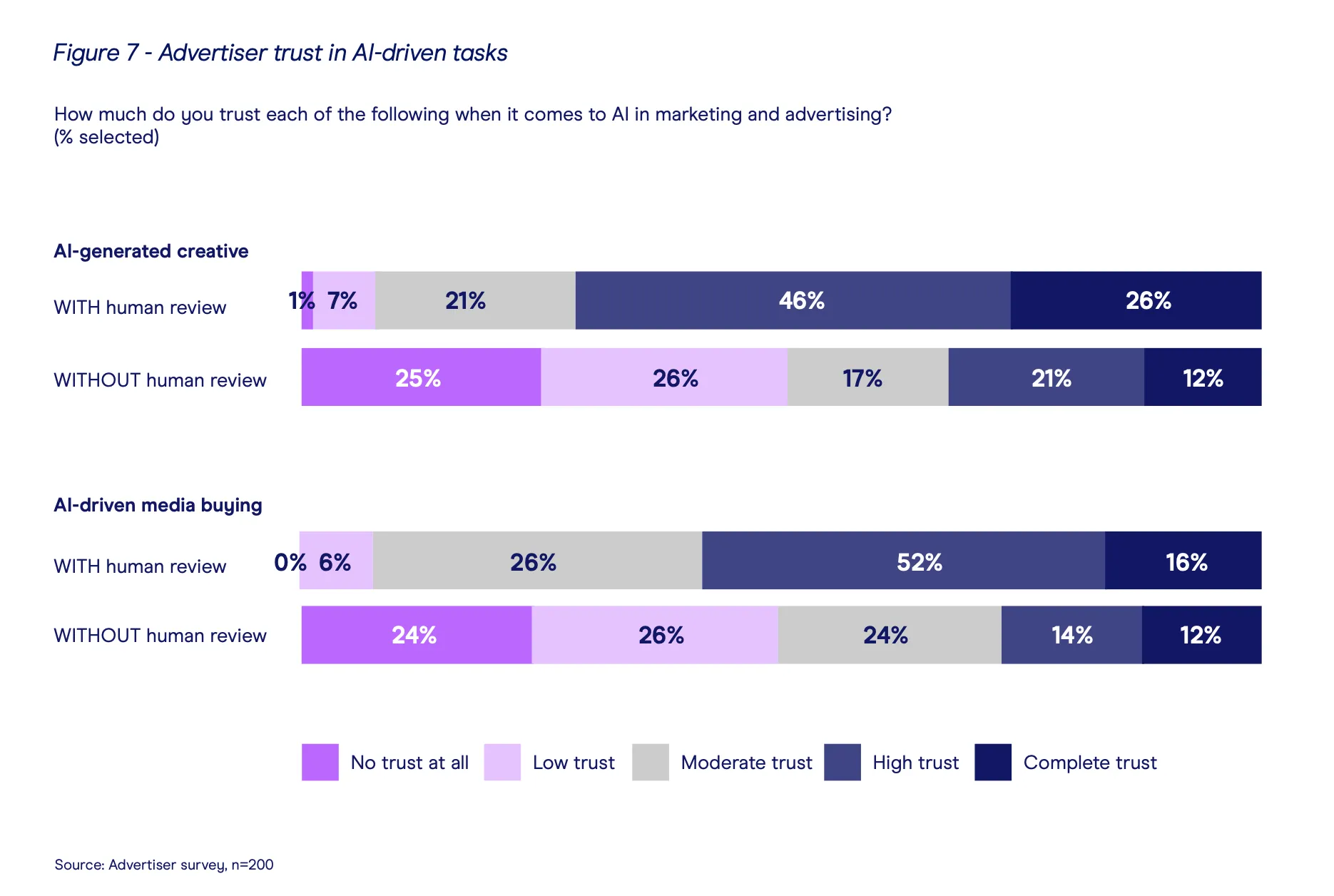
Consider what an AI media-buying agent is built to do: read the auction, weigh the signals, move the budget, faster and more often than a human desk could. Then consider how far advertisers will actually let it. The report asked. With a human reviewing the agent's decisions, sixty-eight percent of advertisers reported high or complete trust in AI-driven media buying. With the human removed, that figure falls to twenty-six. Same agent, same logic, same outputs. The only variable that changed is whether a person was watching, and trust fell by almost two-thirds.
The implication deserves stating plainly, because the report does not. An industry that trusts an agent only while a human supervises it does not trust the agent. It trusts the supervisor. And the entire economic promise of agentic trading, the speed and the scale that underwrite that third-of-spend forecast, depends on the agent operating faster than any supervisor can follow. Machine-speed autonomy and continuous human review are not complementary. They are mutually exclusive. The trust data shows the industry has quietly chosen the supervisor, which is the safe choice, and also the one that means the autonomy on the cover does not yet exist.
The scepticism runs the whole chain
The advertisers are not the most cautious participants in the report. Their customers are.
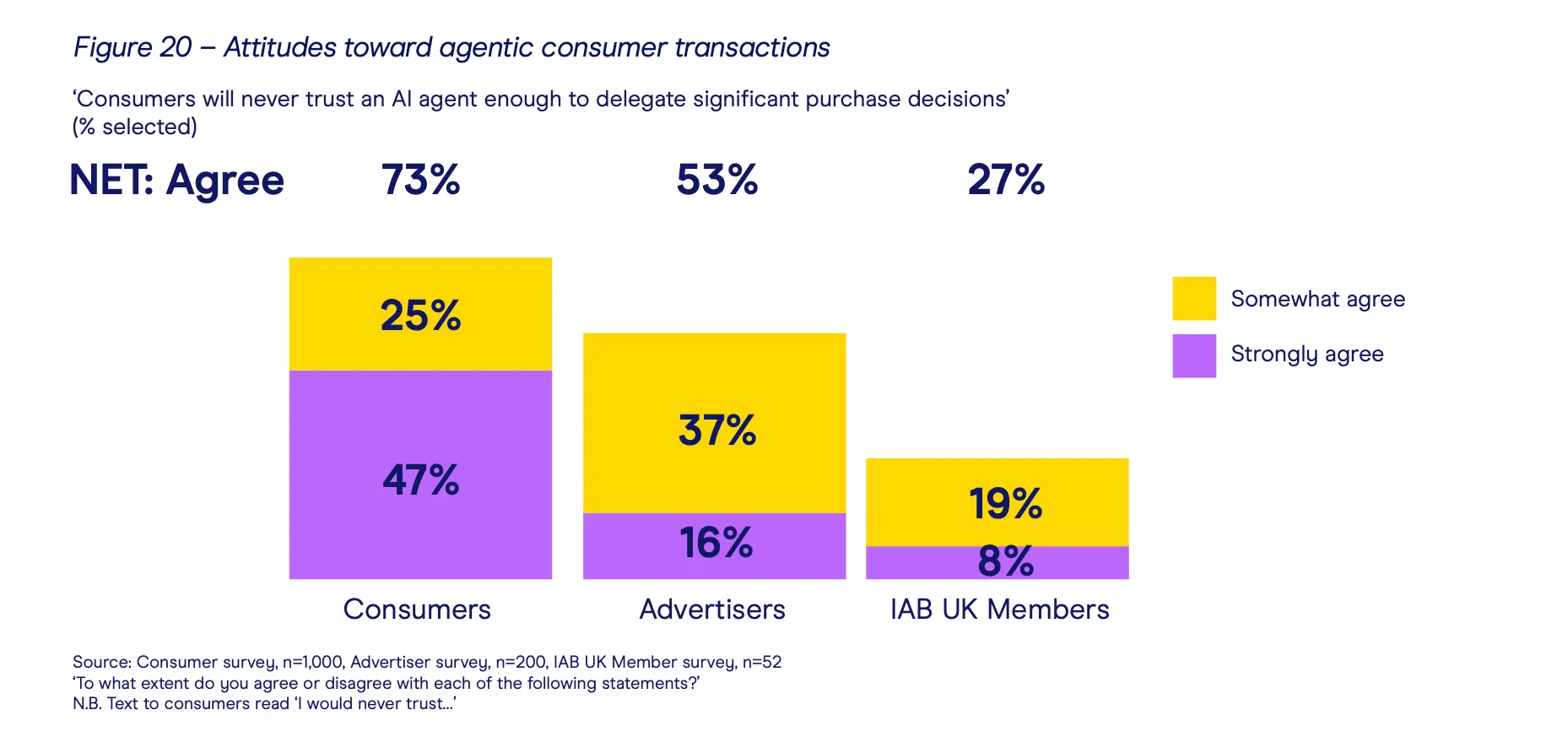
Seventy-three percent of consumers say they would never trust an AI agent enough to let it make a significant purchase on their behalf. More revealing is how badly the industry reads this. Among IAB members, only twenty-seven percent believed consumers felt that way; advertisers estimated fifty-three. The people building the autonomous funnel are out by forty-six points on how much the public actually wants one. The report names the distance between industry confidence and consumer caution a critical gap, and it surfaces wherever the survey looks. Consumers will happily let AI research and compare. Only twenty-three percent are comfortable letting an agent complete a purchase.
The trust problem, then, is not a quirk of the trading desk. It runs the full length of the chain, from the advertiser who will not let an agent buy media unwatched to the shopper who will not let one buy anything at all.
The question the report keeps asking and cannot answer
The sharpest voices in the report are not asking for cleverer agents. They are asking for receipts.
Sean Betts of Omnicom Media, quoted three separate times and makes the same argument each time: for high-risk actions, changing budgets, launching campaigns, moving live spend, deterministic systems with validation and audit trails matter more than handing control to a probabilistic agent. Ross Webster, an AI governance consultant, reduces it to a single question. If no human is in the decision and no human can explain it, where does accountability sit? The report has a term for this, the accountability gap, and in its agentic-trading section it concedes, in writing, that agentic systems add another layer of opacity to a programmatic ecosystem already regarded as opaque. Programmatic's original difficulty is that buyers cannot see where the money went. On the industry's own account, its flagship new technology makes that worse. Data security, opaque decision-making and unsafe placements were each rated a major or significant concern by at least sixty percent of advertisers.
The regulator has now made the stakes concrete. In March the Competition and Markets Authority published guidance stating that a business is responsible for what its AI agent does in exactly the way it is responsible for an employee, third-party tooling notwithstanding, with fines reaching ten percent of global turnover. The remedy the guidance prescribes is, word for word, to keep a human in the loop, actively checking. So the trade body and the regulator, approaching from opposite directions, arrive at the same instruction: a human, watching, indefinitely. That is not a route to autonomy. It is a permanent supervisory burden with legal liability attached.
Who the opacity falls on
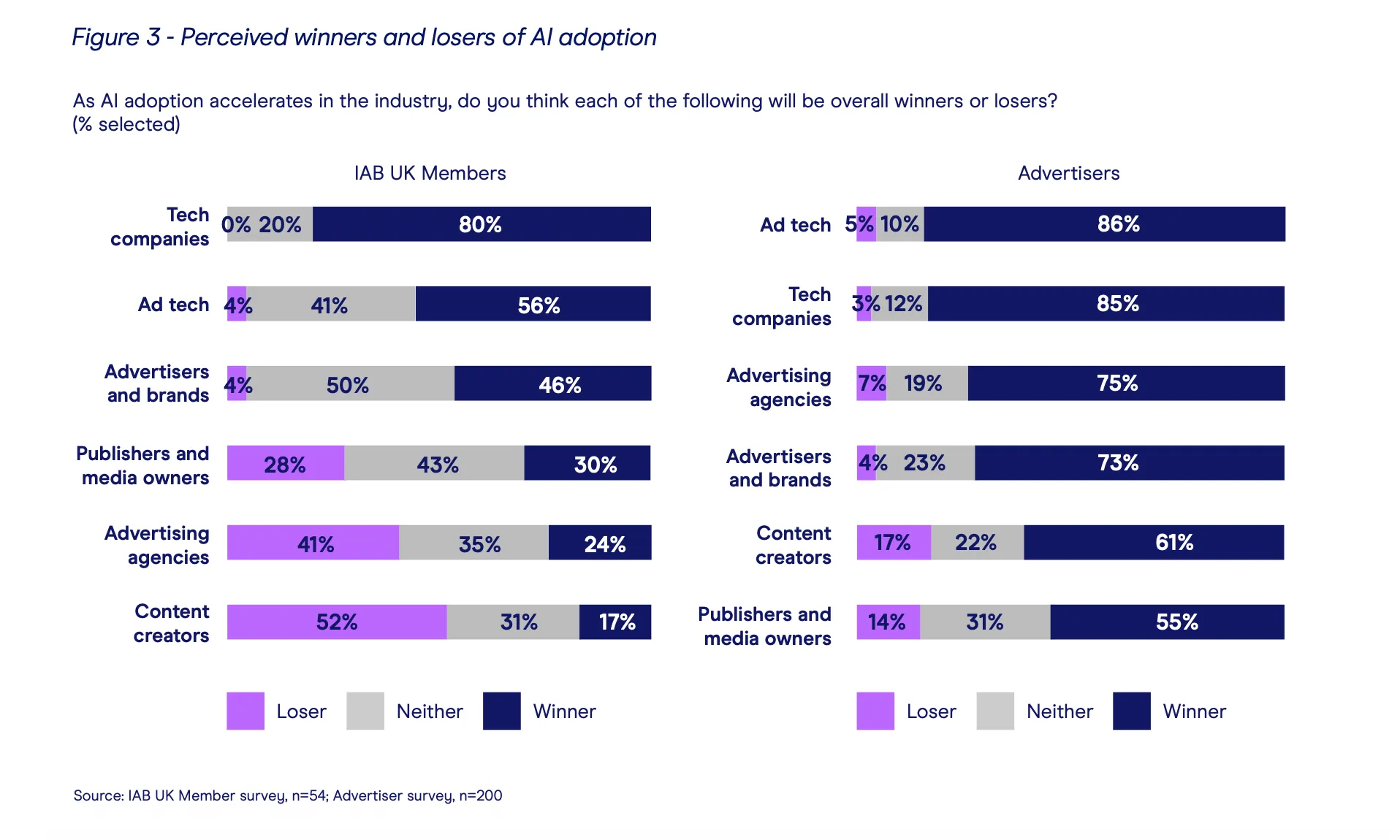
There is a second chart worth reading alongside the trust data, because it identifies who pays for the gap. Asked who wins and who loses as AI reshapes advertising, the industry's answer is unsurprising. Technology and ad tech companies are seen as the principal beneficiaries. Publishers, media owners and content creators are the most likely to be judged at risk, as AI changes how their work is discovered, distributed and monetised.
Set that risk map against the opacity problem and the two turn out to be the same map. The parties the report flags as most exposed are precisely the ones with the least visibility into how the decisions affecting them are made. A publisher cannot contest a valuation it is not permitted to see. A content owner cannot price its inventory against a process it cannot inspect. Opacity is not a cost the market shares evenly. It falls hardest on whoever sits furthest from the decision, and the report has just identified who that is. A verifiable record changes the position of exactly those parties, because it replaces a valuation taken on trust with one that can be checked.
The standards solve speed, not proof
The industry has not been idle. It has been building infrastructure. IAB Tech Lab's Agentic Real Time Framework is capable engineering: it lets agents run inside the auction in co-located containers and cuts bid-request latency by as much as eighty percent. Its authors describe it, fairly, as a control plane for an agentic future.
It is worth reading what the framework is designed to do. It makes agents fast, and it keeps each party's logic private. The communication channel between them is open; the box stays closed. That is the correct design for protecting proprietary code inside a shared environment. It does nothing to make what an agent did provable to the counterparty it traded with. The same pattern holds across the roughly ten competing protocols the report counts on the commerce side. Each addresses how agents talk and how agents pay. None addresses how either side confirms, after the fact, that the deal both agents agreed to is the deal that actually settled. The industry is standardising the conversation and leaving out the receipt.
The missing primitive is verifiability
The property the report never names is verifiability. Not trust, and not oversight. Verifiability: a single record both parties can independently check and neither can quietly alter.
Aviation settled this question decades ago. The autopilot is not trusted because a pilot watches every input. It is trusted because everything it does is written continuously to a recorder built to survive the crash, so the rare flight that goes wrong can be reconstructed exactly and the lesson fed back into every aircraft afterwards. Advertising borrowed aviation's phrase and inverted its meaning. In advertising, the black box is the thing no one can see into. In aviation, it is the thing that makes trusting automation possible.
An agent does not need a chaperone if it can prove its own work. Once one side can prove it, the economics shift quickly. An agent that can verify its trade is one another agent will transact with at full speed. An agent that cannot becomes a risk the counterparty must price, and then route around. The report half-arrives at this itself. Its closing assessment is that the near-term ceiling is not full autonomy but conditional autonomy, agents operating inside strict budgets, permissions and human guardrails. In plain terms, that is the report conceding that the autonomy on its cover is not reachable on the current architecture. Guardrails are what a system builds when it cannot verify. Verification is what lets the guardrails come down.
This is the architecture Alkimi Research set out in Agree. Transact. Verify., published in May. Across more than ninety thousand simulated agentic deals, separate record-keeping produced disagreement in 95.3% of transactions, not through malice or error but through the ordinary mechanics of two systems each maintaining their own state. A shared, verifiable record that both sides write to and reference throughout a deal reduced that divergence to a fraction of a percent, removed the need for after-the-fact reconciliation entirely, and generated more deal value from the same agents in the same market. The paper publishes its methodology, its seed counts and its simulation code in the open, on the explicit basis that the argument should be tested rather than taken on trust. That openness is the point. It is also the difference between research and marketing.
Read against the IAB's report, the two documents form a single thought. One measures, in careful detail, an industry that needs to trust agents it does not currently trust, and whose customers trust them less still. The other sets out the primitive that closes the gap. The report's title is a promise: automation to autonomy. The asterisk is in its own charts, in the place where the optimism gives way to the trust data. The firms that read the asterisk first will build the architecture that makes the promise true. The rest will go on paying a human to watch.
The full report, The State of AI in Advertising: Charting the Shift from Automation to Autonomy, is published by IAB UK. The Alkimi Research paper Agree. Transact. Verify. is available at research.wpp.com; its methodology and simulation codebase are available from ben@alkimi.org.