For most of its history, television advertising ran a door policy, and the barrier was never the screen. It was the transaction. A brand did not need a better idea to get onto television. It needed a media-buying department, an agency relationship, and enough budget to commit to negotiated blocks of airtime months in advance, at the upfronts, in six-figure lumps. The screen was reachable in principle by anyone. The apparatus required to buy it was not.
That is the fact worth holding onto, because it explains both halves of what has happened to connected TV in 2026. The channel did not become accessible because streaming invented a cheaper screen. It became accessible because the transaction underneath it changed shape. And the same change that opened the door also carried in a problem that television, for all its gatekeeping, never had.
The old model was exclusive by design, not by fault
It is tempting to describe the way television used to be bought as broken. It was not. Negotiated, agency-mediated, upfront-committed buying did exactly what it was built to do: it sold guaranteed reach at scale to advertisers large enough to plan a year ahead and absorb the minimums. For a national brand launching a product to an entire country, that model remains coherent. The problem was never that it failed the advertisers inside it. The problem was that its structure decided, in advance, who counted as an advertiser at all.
The first wave of digital television buying did little to change this. Self-serve demand-side platforms existed, but they were designed for the largest spenders, carried high minimums, and demanded trained operators to run them. A brand without a dedicated programmatic function was, in practice, still locked out. The tools had changed. The eligibility test had not.
What changed in 2026
Three shifts arrived close together, and together they dismantled the eligibility test.
The first is that connected TV buying went programmatic at scale. Around 84% of US CTV ad spend now transacts through programmatic pipes rather than negotiated deals, according to eMarketer, with a growing share of inventory biddable in open or private auction rather than sold by direct handshake. This is the structural pivot. In a negotiated market, the minimum is whatever a seller will contract for. In an auction, the minimum falls to the clearing price of a single impression. The floor stopped being a commercial term and became a market outcome.
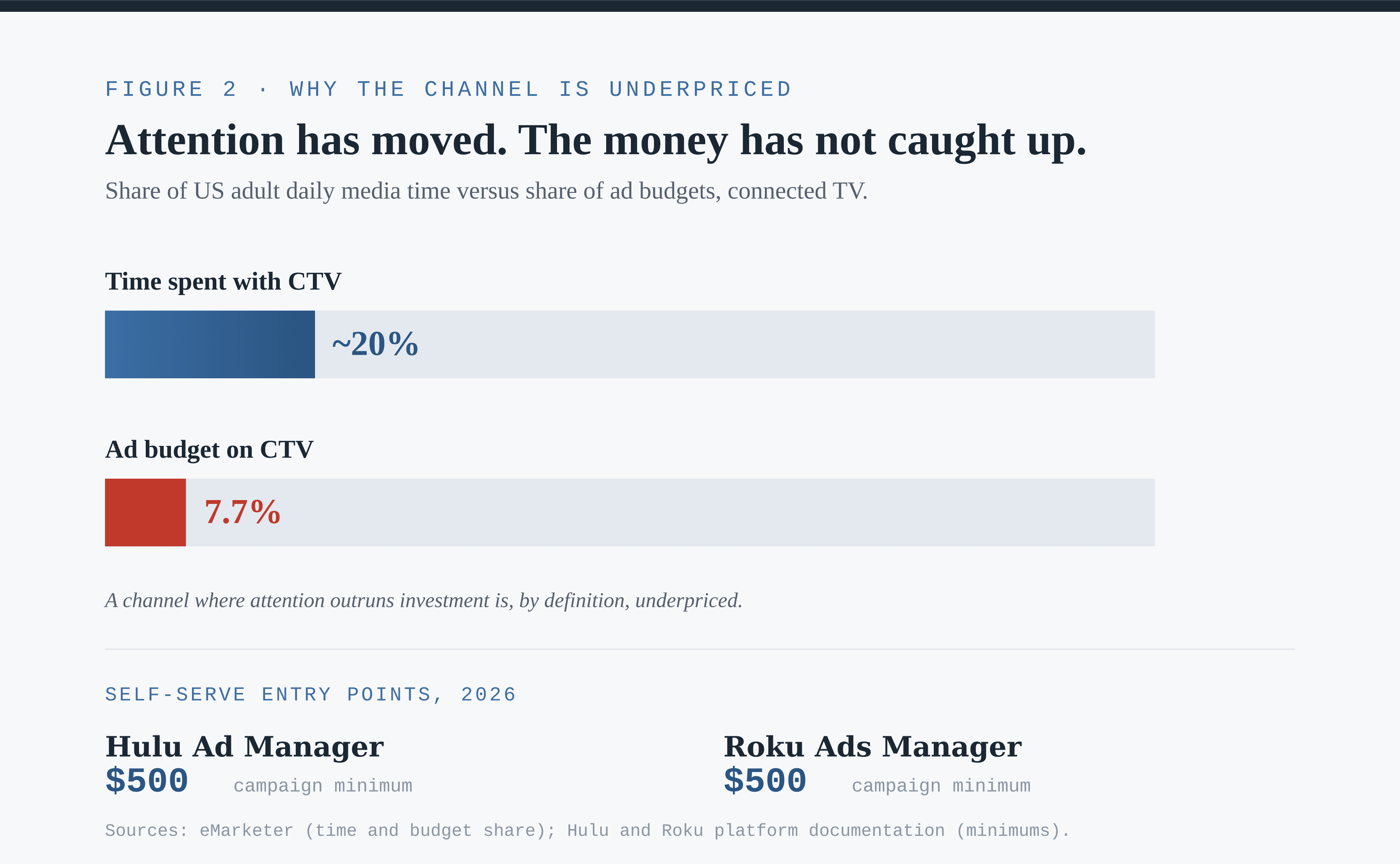
The second is that self-serve platforms brought the floors down to social-media levels. Hulu's self-service Ad Manager markets explicitly to businesses of all sizes with campaign minimums of $500, and Roku's Ads Manager opens campaigns at the same $500. Programmatic self-serve tools are now widely characterised as making a CTV launch about as involved as building a social ad set. The operational barrier, the thing that once required a trading desk, has collapsed into a browser and a payment method.
The third is supply. Every streaming service that introduced an ad-supported tier added biddable inventory to the pool. Netflix's ad tier grew from roughly 70 million monthly users in 2024 to more than 250 million global monthly active viewers by its May 2026 upfront, and free ad-supported services such as Tubi, Pluto and The Roku Channel now reach well over 125 million monthly US viewers, on eMarketer's figures. Abundant inventory erodes scarcity pricing, and scarcity was a large part of what kept the cost of entry high.
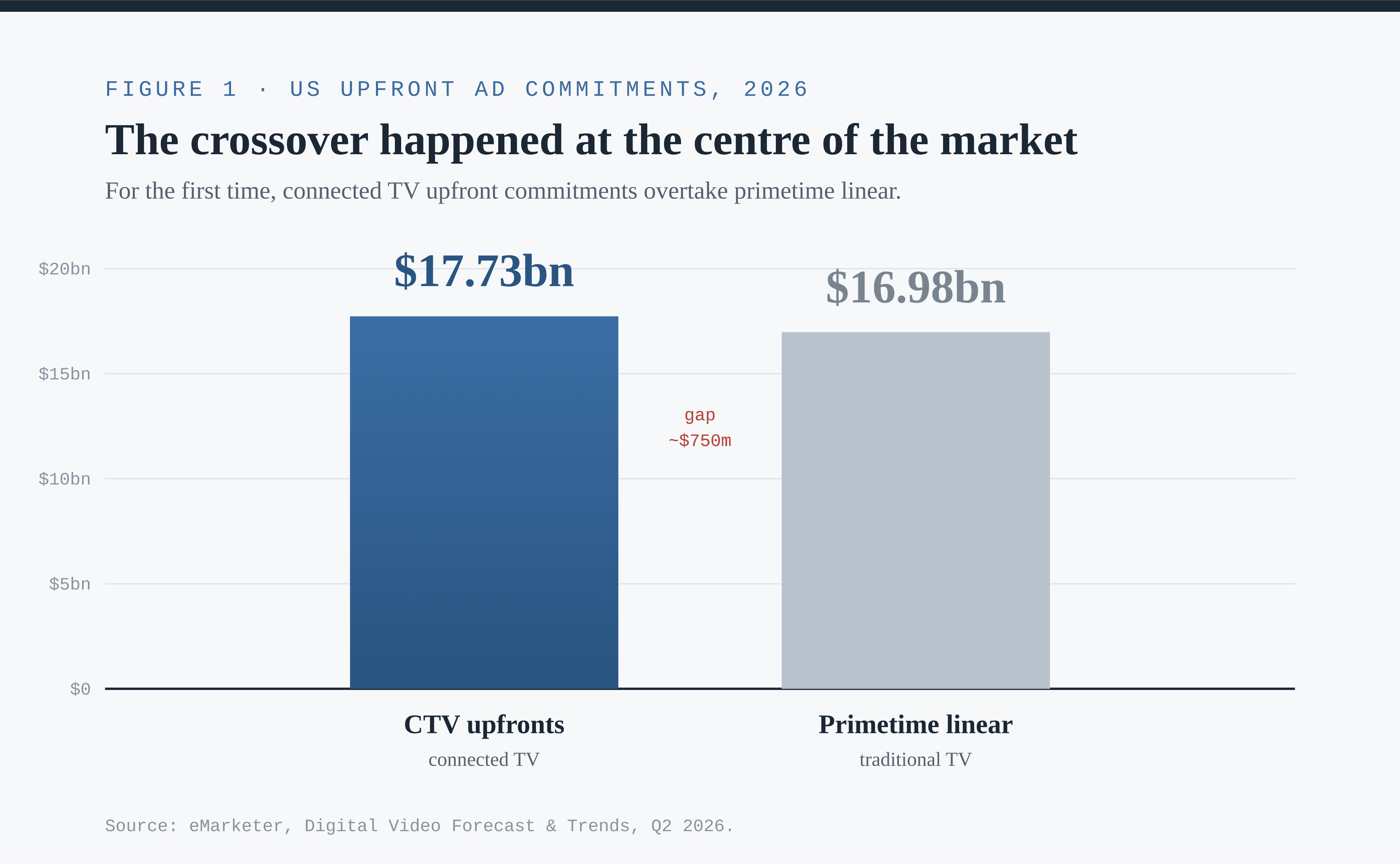
The clearest signal that this is a permanent reordering rather than a cyclical one is where the committed money now sits. In 2026, US CTV upfront ad commitments are forecast to reach $17.73 billion, overtaking primetime linear TV upfronts at $16.98 billion for the first time, on eMarketer's numbers. The shift is happening at the centre of the market, not at its margins.
Why size stopped deciding who gets on the screen
The economic logic of old television favoured large advertisers because the product on sale was undifferentiated reach. Buying that product made sense only for brands whose addressable market was, roughly, everyone. An advertiser selling in three metropolitan areas gained nothing from paying to reach fifty states.
Connected TV reverses the logic. Its advantage is precision, not mass, which is precisely the attribute that large-scale linear buying could not offer. A regional or mid-sized brand can now place a television-quality impression on the largest screen in the household and direct it only at the audiences and geographies it actually serves. This is not a scaled-down television campaign. It is a structurally different buy, and it happens to suit smaller advertisers better than it suits the reach-buyers the old model was designed for.
The timing compounds the point. US adults now spend approximately 20% of their daily media time with connected TV, while only around 7.7% of advertising budgets have followed, according to eMarketer. A channel where attention has outrun investment is, by definition, underpriced, and underpricing rewards early entrants disproportionately. The medium has also matured to a point that makes entry worthwhile rather than merely cheap: the average fifteen-second CTV ad completes at 94.5%, per Statista, and interactive formats have moved from novelty to performance lever, with QR-code usage in CTV ads more than tripling year on year, on Innovid's data, and interactive units lifting unaided recall by 36% in BrightLine research.
The access problem solved itself. The accountability problem did not.
Here the second half of the story asserts itself. The programmatic infrastructure that removed the barrier to entry is the same infrastructure that governs the open web, and it carried the open web's structural weaknesses into connected TV intact.
Consider fees. An Adalytics analysis of open-web programmatic supply chains found that, even when the buyer, the supply path and the publisher domain were held constant, the intermediary share taken on a single impression could vary from 5% to 85%, and connected TV runs on the same infrastructure. That degree of variability makes it close to impossible for an advertiser to predict, benchmark or independently verify what a given impression actually costs in media terms. Industry estimates put the technology, data and supply fee stack at between 15% and 40% of the media budget on certain platforms.
Consider verification. DoubleVerify reported that only half of CTV impressions offered full app-level transparency in 2024; that figure has since risen toward two-thirds, but the blind spot remains material. Pixalate's 2024 supply-path research found that 28% of CTV traffic carrying a supply-chain object marked "complete" was in fact sold by unauthorised sellers presenting themselves as direct, a share that has narrowed in later quarters without disappearing. A direct label, in other words, is not by itself evidence of a direct path.
Consider measurement. Each platform reports against its own framework, and inconsistent measurement ranks ahead of fraud and cost as the challenge advertisers most often name in connected TV, according to research from the ANA and Innovid. The result is an environment rich in data and poor in agreement, where the same conversion can be claimed by several systems and reconciled by none.
The conclusion is uncomfortable but clean. Access to the connected television screen has been democratised. The ability to see what one paid to reach it has not. Walking through the door is now available to any budget. Auditing the room on the other side remains a specialist capability, and for most advertisers it is simply absent.
What accountable access looks like
This is the gap Alkimi's connected TV proposition is built to close, and it is the reason access and accountability are best treated as one question rather than two. The premise is that an impression is only worth what actually reaches the screen, so the architecture is built to remove intermediaries rather than to layer reporting on top of them. The measurement that proves a campaign worked is included within the minimum spend rather than sold back as an upsell, on the reasoning that independent verification of outcomes should be a default of the buy, not a premium feature layered over it.
None of that setup is any harder than the platforms an advertiser already knows. It is self-serve. It runs on the creative a brand is already using elsewhere. A CTV pilot runs over three to four weeks, alongside an advertiser's existing stack rather than in place of it, on a test budget rather than a committed one. The point of that structure is to make the comparison, not the commitment to the decision a brand of any size is asked to take.
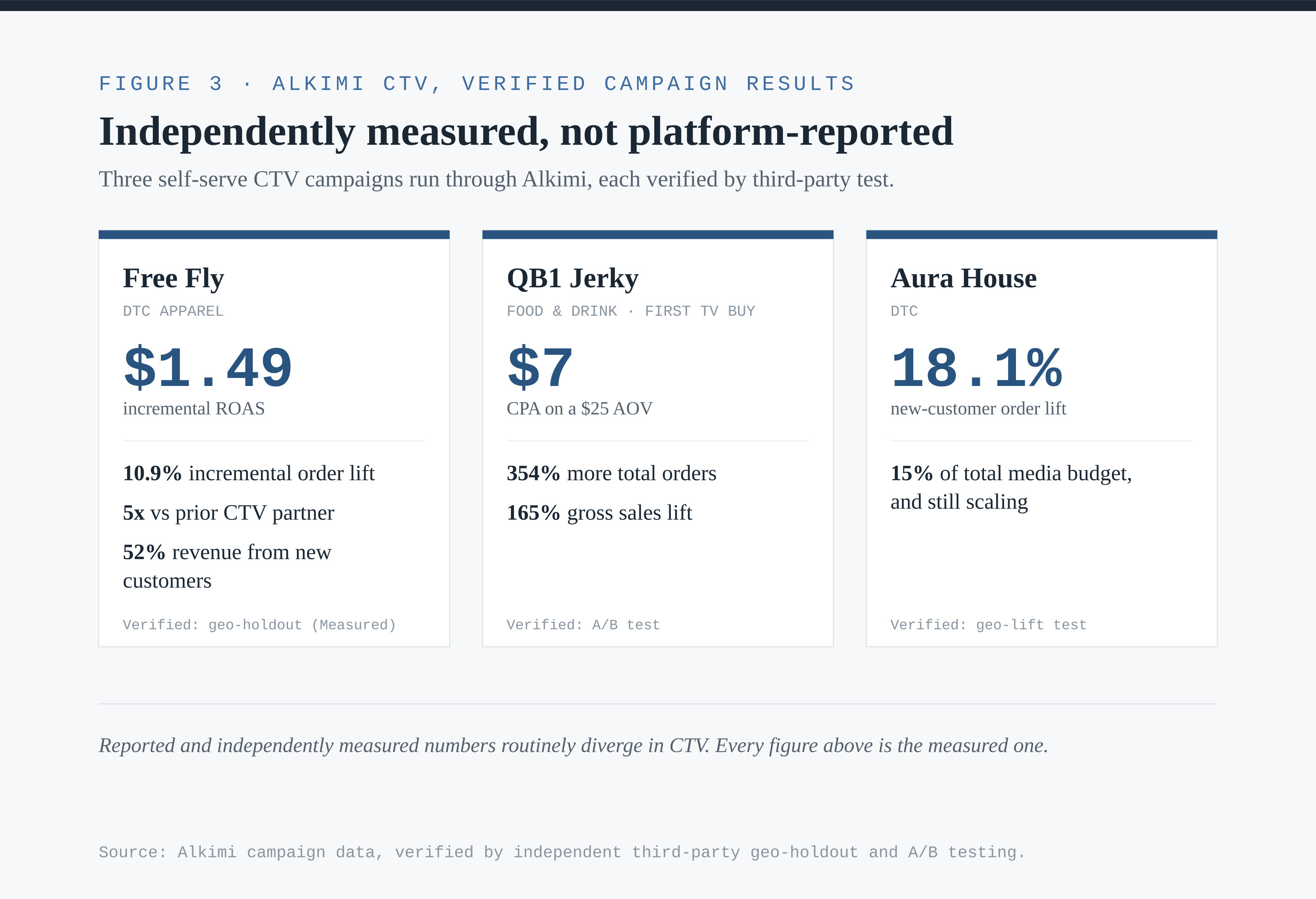
The results Alkimi points to are its own live CTV campaigns, each measured by an independent third party rather than reported by the platform, which is the distinction that matters in a channel where reported and measured numbers routinely diverge. Free Fly's most recent campaign delivered a $1.49 incremental ROAS and a 10.9% incremental order lift, five times stronger than its previous CTV partner, with 52% of that revenue coming from new customers, verified by a geo-holdout test run by Measured rather than by platform-reported figures. QB1 Jerky's first-ever streaming campaign landed a $7 CPA against a $25 average order value, with 354% more total orders and a 165% gross sales lift, verified by A/B test. Aura House added streaming to a paid-social programme that had hit a ceiling on Meta and Google, and it now accounts for 15% of the brand's total media budget and is still scaling, on an 18.1% new-customer order lift measured by geo-lift. The common thread is not the headline number. It is that every number is the independently measured one.
The door is open. The question is whether a brand can see through it.
The most important development in television advertising in 2026 is not that streaming won. It is that the transaction stopped functioning as a gate. Any advertiser, at any size, can now place a premium television impression against exactly the audience it wants, starting at a budget that would once have been a rounding error on an upfront commitment.
What separates the advertisers who benefit from that opening from the ones who quietly leak budget through it is not spend, and it is not sophistication. It is visibility: whether a brand can see how much of its money reached the screen, and confirm that its ad ran where it was told it would. The channel democratised the first half of that question. The second half is the one still worth solving.
To model an accountable connected TV campaign against current spend, contact lauren@alkimi.org.
Related reading from Alkimi Research
Measurement Isn't Verification: Fifteen Years of Self-Graded Essays. The accountability problem underneath the access story, and why platform-reported numbers were never proof.