
11 Nov 2026 · 8 min read
Earned Autonomy: A Worked Example for AI Media-Buying Agents
TL;DR: Earned autonomy means an AI buying agent moves through five stages, from watching to acting on its own, only as it proves reliable on one specific kind of decision. This piece follows a single decision through all five, using illustrative numbers to show what the evidence would look like.
The claim, and the honest test it has to pass
Earned autonomy is easy to state and easy to dismiss. Of course a responsible AI system should start supervised and win more independence as it proves itself. That sounds sensible whether or not it describes anything real, which is exactly the problem. A model that only sounds sensible is marketing.
The honest test is not whether the idea holds up in the abstract. It is whether a specific decision, with specific inputs, has actually moved through the stages for a specific workflow, and whether that movement can be checked against evidence rather than simply asserted.
So this piece does the thing most descriptions of earned autonomy skip. It follows one decision, all the way through, with numbers at every step. The numbers here are illustrative. They are not drawn from a live deployment, and they are not a performance claim. They exist to show what the evidence looks like when the model is working, so you know what to ask for when someone tells you their agent has earned its independence.
The decision: accepting a price on a repeat buy
Here is the decision we will follow. A buying agent has to decide whether to accept a counterparty's proposed price on a repeat inventory purchase, inside a category and budget band the two parties have bought in before.
It is a good test case for two reasons. It repeats often enough to generate real evidence quickly, so a track record builds in weeks rather than years. And the cost of a wrong call is bounded rather than catastrophic, which is exactly the kind of decision earned autonomy is meant to govern. Nobody should be auto-approving a bet-the-company contract on the strength of a hundred clean repeat buys.
To make the story concrete, picture one workflow. Call it display inventory in a single category, with a budget band of 8,000 to 12,000 US dollars a buy, running at roughly forty buys a week. A worked example of the kind that follows, not a real account. Every number from here on is invented to illustrate the mechanism.
Five stages, one decision
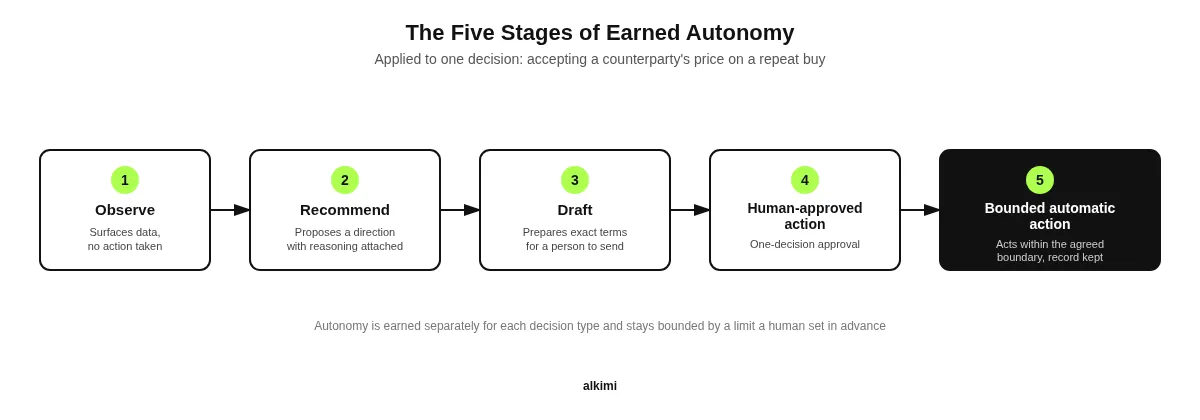
Follow the same decision from the day the agent is switched on.
Stage one: Observe
In the first fortnight the agent does nothing but watch. For every buy that lands, it surfaces what the counterparty is offering and how that compares to the last several deals in the same category. It takes no action and makes no recommendation. A person decides every buy exactly as they did before the agent existed.
The point of this stage is to build a record of what the agent would have flagged, set against what a person reviewing the same data independently flagged. After eighty buys, say the agent's read of whether a price sat inside recent precedent matched the human reviewer's on seventy-six. Four disagreements, all worth reading. This is not yet trust. It is visibility, and a baseline to measure everything after.
Stage two: Recommend
Now the agent proposes a specific action on each buy, accept or counter, with its reasoning attached. Here is the price, here is how it sits against the last ten deals, here is why accepting or countering makes sense. A person still decides every buy. What has changed is that they are weighing a structured recommendation rather than raw numbers.
Each recommendation gets checked afterwards against what the person decided. Across the next two hundred buys, suppose the human accepted the agent's recommendation on a hundred and ninety-one, overrode it on nine, and that on review seven of those nine overrides were the person catching something real. The agent is useful here, and visibly not yet reliable enough to lean on. That gap is the whole reason there are three more stages.
Stage three: Draft
Rather than only pointing a direction, the agent now prepares the actual terms of a counteroffer. The specific price, the volume, any conditions, written out for a person to review and send. This is a meaningfully harder task than saying accept or counter, because drafting means getting the commercial terms right, not just the direction.
The measure changes with the task. Not was the direction correct, but did the drafted terms go out unedited. Over a hundred and fifty drafts, say a hundred and thirty-one were sent with no change, and the rest were tweaked before sending, most often on a condition rather than the price. Eighty-seven per cent clean is strong, and the thirteen per cent is where you learn what the agent still gets wrong.
Stage four: Human-approved action
The drafts are good enough now that a person approves the exact terms the agent wrote with a single decision, rather than composing anything themselves. The human's role shifts from author to approver. A person is still required for every single buy, so this is not yet automation, but it is a real change in workload, and the approval rate is the thing to watch before the last step.
Suppose that over three hundred buys the approver accepted the agent's drafted terms as written on two hundred and ninety-four of them, a hair under ninety-eight per cent, with the rejections clustered in one fortnight when a supply shift moved the whole category and the agent was slow to follow. That cluster matters more than the headline rate, because it shows the one condition under which this decision is not yet safe to leave alone.
Stage five: Bounded automatic action
Only after the decision has been approved correctly and consistently across enough repeat instances to earn it does the agent accept or counter inside the agreed band without a person reviewing that specific buy first. In this story, after several hundred buys at ninety-eight per cent and a fix for the supply-shift lag, the agent runs the ordinary case on its own.
Two things still hold. Every action stays visible afterwards in a retrievable record, so an auto-accepted buy can be read back the next morning. And the boundary still binds. The band of 8,000 to 12,000 dollars in this one category is the edge of what the agent may do alone. A buy at 15,000, or in a category it has no record in, does not ride along on this decision's track record. It drops back to a stage with a person in it. Nothing outside the specific, earned boundary moves to automatic just because one decision type did.
The shape of earning it
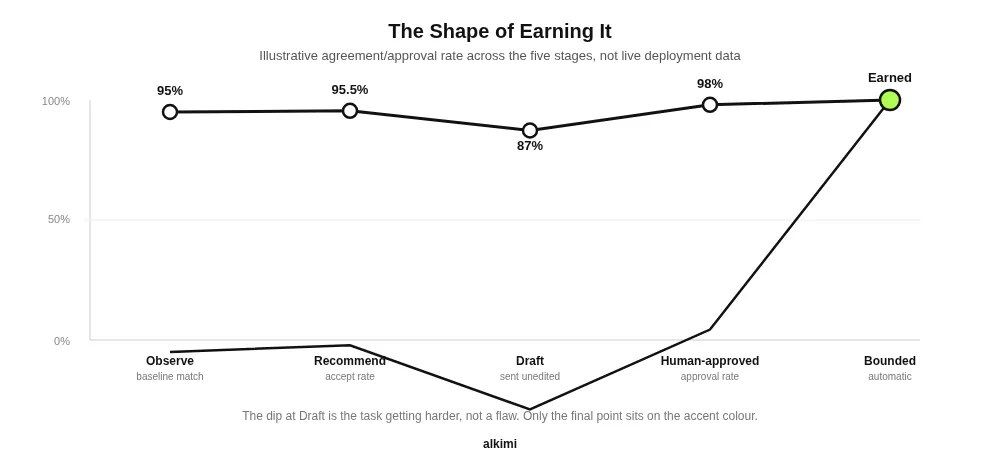
The dip at Draft is the point, not a flaw. Each stage sets the agent a harder task, so agreement falls when the task changes and has to be won back before the next stage is earned. Only the final point, where the agent decides the ordinary case itself, sits on the accent colour. Everything to its left still has a person in the loop.
Why this can be proved wrong, and a roadmap can't
Everything above is invented, and that is the point of it. Walking through one decision this way makes a specific, checkable claim: for this workflow, this is the stage reached, and here is the evidence that justified moving it there. Swap the illustrative numbers for real ones and the claim can be challenged. You can ask to see the overrides. You can ask what happened in the fortnight the approval rate dipped. You can ask why the band stops at 12,000 dollars. Every one of those questions has an answer that is either there or not.
A general statement that an AI system is becoming more autonomous over time cannot be checked against anything, because it never specifies which decision, what evidence, or what the boundary actually is. There is nothing to ask for, so there is nothing to catch.
That is the whole difference between a working system and a roadmap. One pins the claim to a single decision, with a number and a boundary you can interrogate. The other works only as a description of intent. When a vendor tells you their agent is autonomous, the useful move is to ask them to pick one decision and show you its track record and its band. The quality of that answer tells you which of the two you are dealing with.
Frequently asked questions
Does every decision have to reach stage five?
No. Earned autonomy is evaluated separately for each decision type. The buying agent in this story might reach stage five on repeat buys in a known category while sitting at stage two on a decision it meets rarely, or one where a mistake would cost far more.
What happens if an agent at stage five makes a mistake?
The boundary keeps the cost of any single mistake contained rather than catastrophic, and the retrievable record lets a person find the mistake and move that decision type back to a stage with more oversight. In the story, the supply-shift cluster at stage four is exactly the kind of signal that would trigger that move.
Is earned autonomy the same as full automation?
No. Even at the final stage the agent works inside a boundary a person set in advance and did not change, and every action stays visible in a record afterwards. Full automation with no boundary and no record is a different and much riskier proposition.
How is this different from a vendor simply claiming its agent is autonomous?
A specific decision type, with a specific boundary and a specific history, is a claim you can check. A general claim of autonomy, with no named decision, no stated boundary and no retrievable history, cannot be verified either way. That is the distinction worth asking any vendor to resolve.