
2 Nov 2026 · 3 min read
How a Deal Actually Moves Through the Negotiation Engine
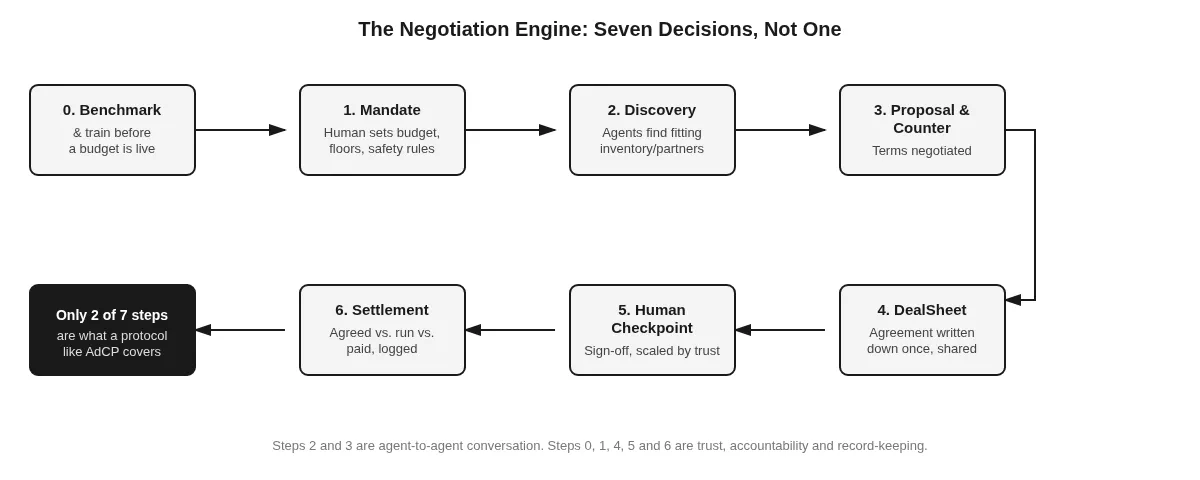
"Negotiation engine" gets used as if it is one thing. It is not. It is seven decisions in sequence, and most of the AdCP and AAMP conversation only covers two of them. Here is the whole map.
0. Benchmark and train, before anything else
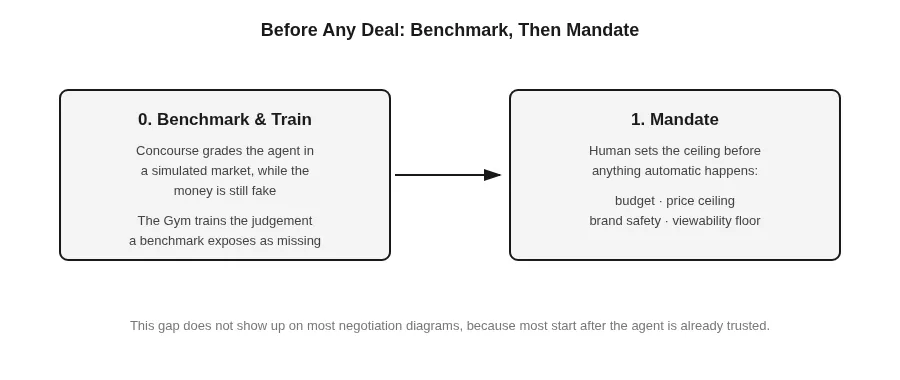
Before an agent gets near a live budget, it gets graded. Concourse runs it against a simulated market so you find out how it behaves under pressure while the money is still fake. The Alkimi Gym is where it gets trained on the judgement a benchmark exposes as missing, holding a floor, knowing when to walk, recognising a bad deal dressed up as a finished one.
This step does not show up on most negotiation diagrams, because most negotiation diagrams start after the agent is already trusted. That is the gap.
1. Mandate
The buyer sets the guardrails before the agent is allowed to act: budget, price ceiling, brand safety rules, viewability floor, which publisher environments are in or out. This is the one decision a human makes before anything automatic happens, and it is the ceiling everything downstream has to respect.
2. Discovery
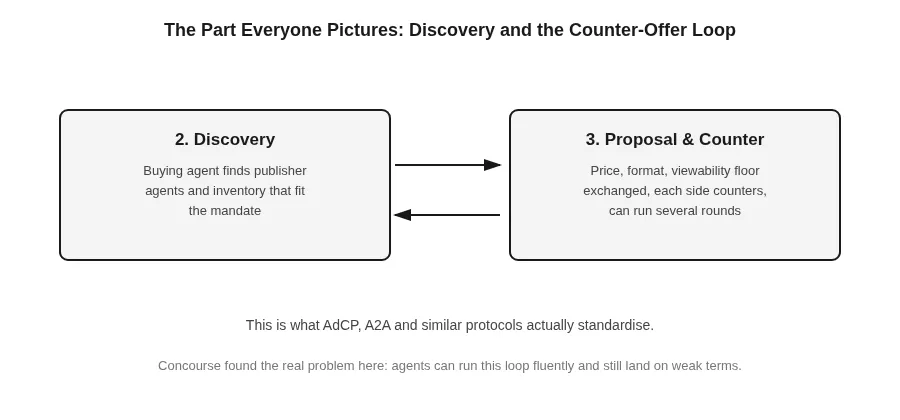
The buying agent finds publisher agents and inventory that fit the mandate. This is the part that looks most like plumbing, and it is also where AdCP and similar protocols do real, useful work, giving agents a shared way to ask "what do you have" and get back a structured answer instead of a phone call.
3. Proposal and counter
Terms get exchanged. Price, format, placement, viewability floor, brand safety terms. Each side proposes, the other counters, and this can run several rounds. This is the step everyone pictures when they say "negotiation," and it is also the step where Concourse found the real problem: agents can run this loop fluently and still land on weak terms, because sounding like a negotiation and producing a good one are not the same test.
4. Agreement, the DealSheet
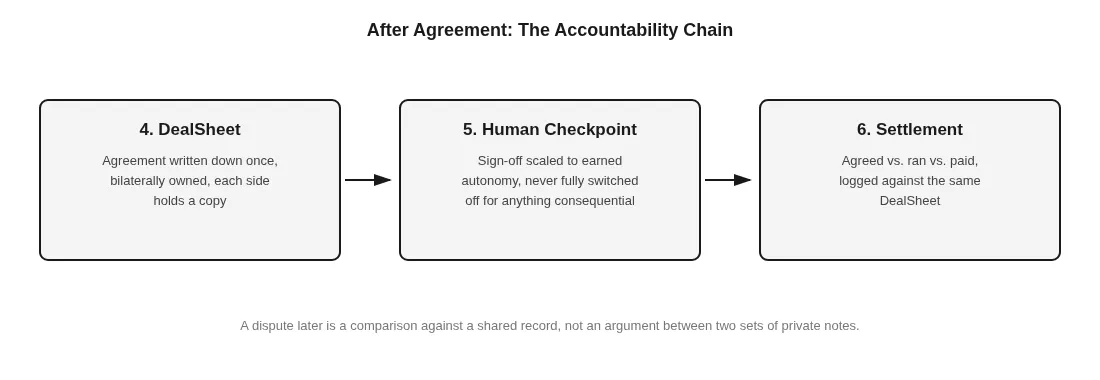
When both sides land on terms, that agreement gets written down once, as a DealSheet, bilaterally owned and cryptographically private. Each side holds a copy of exactly what was agreed. This is the piece most of the industry is still missing: a shared record of a deal that is not just each side's own internal notes about a conversation that happened.
5. Human checkpoint
Depending on how much trust the agent has earned, a human signs off here. Early on, every deal gets a human look before it executes. As the agent proves itself against real outcomes, that checkpoint moves further along, but it never disappears entirely for anything consequential. Autonomy here is earned a decision at a time, not switched on by default.
6. Settlement
The campaign runs. What was agreed, what actually ran, and what was paid all get logged against the same DealSheet, so a dispute later is a comparison, not an argument. This is also where most of the "unknown spend" problem in programmatic has always lived, two parties each keeping their own version of events with nothing to reconcile them against.
Why the map matters more than the model
Put the seven steps next to each other and the pattern is obvious: only steps 2 and 3 are about communication between agents, which is what AdCP, A2A, and similar protocols actually standardise. Steps 0, 1, 4, 5 and 6 are decisions about trust, accountability and record-keeping, and no protocol for agent conversation answers any of them.
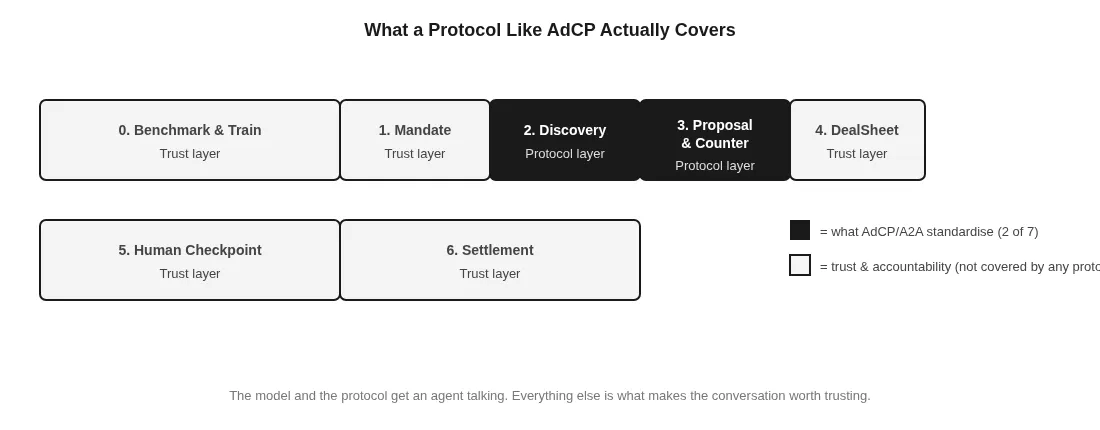
That is the whole argument in one sentence: the model and the protocol get an agent talking. Benchmarking, mandates, the DealSheet and a human checkpoint are what make the conversation worth trusting.